As an Amazon Associate this site earns from qualifying purchases.
Quick Picks
| Product | Platen size | Published temperature range | Notable spec |
|---|---|---|---|
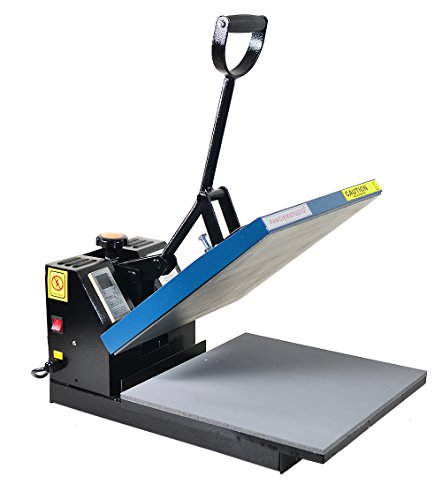
| Fancierstudio Digital Heat Press 15 x 15 Sublimation Rhinestone Heat | 15 x 15 in | 0-699 degrees F | 1800 watts, adjustable pressure, Teflon-coated platen |
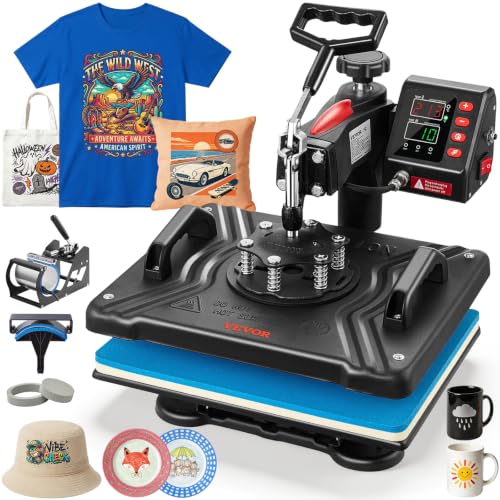
| VEVOR Heat Press Machine 12"x15" 5 in 1 360° Swing Away Shirt Press | 12 x 15 in | 0-450 degrees F | 4 accessory platens alongside the main platen, pressure adjustment knob, over-heat protection |
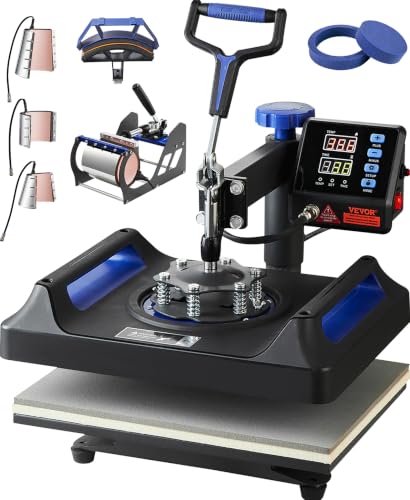
| VEVOR Heat Press Machine 12 x 15 Inch 8 in 1 Heat Press Sublimation Machine 360° Rotation Swing Away 8 in 1 Shirt Printing Machine Dual-Tube Heating for DIY T-Shirts Cap & Mugs Blue | 12 x 15 in | Not stated in the supplied listing | Dual-tube heating, manufacturer-claimed 5 degrees C center-to-edge variance |
Disclosure: We earn a small commission from qualifying Amazon purchases at no extra cost to you.
As an Amazon Associate we earn from qualifying purchases. This page contains affiliate links, and we may receive a commission if you buy through them — at no extra cost to you.
As an Amazon Associate, we earn from qualifying purchases.
Last Updated: September 2026
The Short Answer
Yes, you can use a household iron instead of a heat press for small heat transfer vinyl (HTV) projects. No, it will not give you the same result, and the reason is mechanical rather than mystical: an iron gives you a small, uneven contact surface, a thermostat you cannot read in degrees, and whatever pressure your arm happens to apply that second. A heat press gives you a flat platen, a numeric temperature setpoint, a countdown timer, and an adjustable pressure mechanism.
If your vinyl peels after two washes, one of those four variables is almost always the culprit. Here's how to diagnose it, fix it with what you already own, and decide whether a press is worth the counter space.
The Problem: Why Iron-On Vinyl Peels Off
HTV adhesive needs three things at once — the right temperature, held for the right duration, under consistent pressure across the whole design. Miss any one and the bond is partial. Partial bonds survive the photo you post that night and fail in the wash.
An iron works against you on all three fronts:
- Temperature is a guess. A dial marked "cotton" is not a number. You cannot confirm the soleplate is sitting at the temperature your vinyl manufacturer specifies.
- The soleplate is not flat. Steam holes are voids. Wherever a hole sits, that patch of adhesive gets less contact and less heat.
- Pressure is inconsistent. You lean, you shift, you press harder on the edge nearest you. The center of a large design routinely gets less than the corners, or vice versa.
- Coverage is piecemeal. A design wider than the soleplate has to be done in overlapping passes, which means some areas get pressed twice and some once.
Step-by-Step: Fix a Peeling Transfer Without Buying Anything Yet
Before you spend money, rule out technique. Run these five steps in order.
- Pre-press the blank for 5-10 seconds. Moisture in cotton fights adhesive. Wrinkles create air gaps. Flatten and dry the area first.
- Work on a hard, flat surface. Not an ironing board. A padded board absorbs the downward force you are trying to deliver. A towel on a countertop is better.
- Kill the steam and empty the reservoir. Steam holes already reduce contact; active steam adds moisture at exactly the wrong moment.
- Press small sections and lean in. Use body weight through a locked arm, not wrist motion. Hold each section still for the full duration your vinyl brand specifies — no sliding.
- Cover with a Teflon sheet or parchment, then check whether the carrier peels cleanly at the temperature your vinyl calls for. If corners lift, re-press that section rather than repressing the whole design.
Do I Need a Heat Press for Vinyl?
Not to start. You need one when any of these become true: designs regularly exceed your soleplate, you press more than a handful of shirts at a time, you work with sublimation or rhinestones, or you are selling and cannot afford a return.
That is the honest line. Below it, an iron plus patience is genuinely fine. Above it, you are fighting physics with your shoulder.
Heat Press Pressure and Even Heat, Explained
A press does two things an iron structurally cannot.
It applies repeatable pressure. Amazon's listing for the Fancierstudio Digital Heat Press 15 x 15 Sublimation Rhinestone Heat T-Shirt Machine15x15 B/BLK lists a silicon-gel base board and adjustable pressure [S3]. The listing for the VEVOR Heat Press Machine 12"x15" 5 in 1 360° Swing Away Shirt Press Machine describes a pressure adjustment knob for dialing in the amount needed for a given transfer [S4]. The supplied listing facts for the VEVOR Heat Press Machine 12 x 15 Inch 8 in 1 model do not state a pressure adjustment mechanism. That is a setting you can return to next week, not a feeling in your arm.
It heats a whole platen at once. Even heat is where the specs get interesting. VEVOR's listing for the 8-in-1 model claims dual-tube heating produces a temperature difference of only about 5 degrees C between center and edge, compared with more than 10 degrees C for what it calls old-fashioned single-tube heating [S5]. Treat that as the manufacturer's own claim, not an independently verified figure — but the direction of the argument matches how transfers fail on an iron.
Tools & Products You'll Need
Fancierstudio Digital Heat Press 15 x 15 Sublimation Rhinestone Heat T-Shirt Machine15x15 B/BLK — Best for the largest single-press coverage of these three
The pitch here is platen area. At 15 x 15 inches, this is the largest platen among the three machines covered on this page, which matters directly for the failure mode described above: a design that fits inside the platen gets pressed once, evenly, instead of in overlapping passes. Amazon's listing states a 15-by-15-inch heat press sheet is included, 110 volts, 1800 watts, a temperature range of 0-699 degrees F, and a time range of 0-999 seconds, with electronic time and heat control [S3].
That 0-699 degrees F ceiling is far above anything standard HTV requires; the practical read is headroom, not a reason to use it. The Teflon coating on the heat platen and the silicon-gel base board are both listed [S3].
Strengths: largest platen of the three; published 1800-watt rating; electronic time and heat control; adjustable pressure [S3].
Limitations to weigh: the supplied listing for the Fancierstudio Digital Heat Press 15 x 15 Sublimation Rhinestone Heat T-Shirt Machine15x15 B/BLK describes no accessory platens, so mugs, caps and plates are not part of what this listing covers [S3]. It also does not state the press mechanism. The supplied listing information does not state a warranty length, weight, or duty cycle.
VEVOR Heat Press Machine 12"x15" 5 in 1 360° Swing Away Shirt Press Machine — Best for one machine that also does mugs, caps and plates
If your projects are not just shirts, this is the relevant spec sheet. VEVOR's listing describes a 12 x 15 inch platen plus four accessory platens: a 6" x 3" hat/cap press, an 11 oz mug press, and plate presses with 5" and 6" maximum diameters [S4]. Published temperature control runs 0-450 degrees F with a 0-999s timer on a dual LCD display, plus a pressure adjustment knob [S4].
The 360-degree swing-away arm is listed as moving the hot upper platen aside during loading, which VEVOR ties to keeping vinyl edges from curling [S4]. The listing also cites over-heat protection and a built-in circuit breaker, and states the silicon-gel pad withstands 250 degrees Fahrenheit without distorting [S4].
Strengths: five platens from one purchase; adjustable pressure; audible finish beep; Teflon-coated main platen [S4].
Limitations to weigh: the 450 degrees F published ceiling is lower than the Fancierstudio listing's 699 degrees F figure [S3][S4], and the 12 x 15 platen is smaller than 15 x 15. Swapping accessory platens is a per-project chore.
VEVOR Heat Press Machine 12 x 15 Inch 8 in 1 Heat Press Sublimation Machine 360° Rotation Swing Away 8 in 1 Shirt Printing Machine Dual-Tube Heating for DIY T-Shirts Cap & Mugs Blue — Best for buyers prioritising the published even-heat claim
This is the one to read closely if uneven heat is your specific complaint. VEVOR's listing for this model is the only one of the three that publishes a center-to-edge temperature figure: about 5 degrees C with dual-tube heating, against more than 10 degrees C for single-tube designs [S5]. It also lists a 12" x 15" Teflon-coated platen, a digital controller with dual-screen displays, and a C/F toggle [S5].
On safety, the listing claims two layers of insulation keep the surface at roughly 50-70 degrees C when working temperature reaches 210 degrees C [S5]. Again — manufacturer's figure, not an independent measurement.
Strengths: published even-heat specification; 360-degree swing-away arm described as applying pressure directly and evenly; 8-in-1 kit covering caps, shirts, mugs and plates [S5].
Limitations to weigh: the supplied listing does not state a temperature range, timer range, or wattage for this model, so compare those directly with the manufacturer before buying.
Tips for Best Results
- Follow the vinyl brand's temperature and time, not the machine's maximum.
- Pre-press every blank. It is ten seconds that prevents most peeling.
- Use a Teflon or parchment barrier every press — all three platens above are described as Teflon-coated [S3][S4][S5], but the barrier protects the garment too.
- Record the temperature, time and pressure setting that worked. That is the entire advantage a press has over an iron; write it down or you have thrown it away.
- Let the garment cool fully before the first wash.
Common Mistakes to Avoid
- Pressing on a padded ironing board. It swallows pressure.
- Treating a timer as permission to walk away. These machines run hot; a countdown is not unattended-operation approval. For general household product safety guidance, see CPSC [S1].
- Assuming a bigger temperature range is better. A 0-699 degrees F ceiling [S3] is headroom, not a setting to chase.
- Sizing your electrical setup off a wattage number. The Fancierstudio listing states 110 volts and 1800 watts [S3]; that is the appliance's rating, not a determination about your home's circuit. Ask an electrician.
- Buying for accessories you will not use. If you only press shirts, cap and mug platens are storage.
How We Research
This website does not do hands-on testing. For this page, product facts come from two source types only: Amazon Creators API verified product records and the product listing feature bullets published on each ASIN, all retrieved 2026-09-09. Specifications are compared side by side, attributed to the party that published them, and read for what they imply for a buyer. Where a listing does not state a figure, this page says so rather than filling the gap.
Final Verdict
An iron is a legitimate starting tool for small HTV work — and if your transfers are peeling, fix your technique before you fix your equipment. Hard surface, no steam, pre-press, body weight, full dwell time. That solves most cases.
When you outgrow it, choose on the failure mode that annoys you. If your designs keep exceeding the soleplate, the Fancierstudio Digital Heat Press 15 x 15 Sublimation Rhinestone Heat T-Shirt Machine15x15 B/BLK has the largest platen here at 15 x 15 inches with a listed 1800 watts and 0-699 degrees F range [S3]. If you want shirts plus mugs, caps and plates from one purchase, the VEVOR Heat Press Machine 12"x15" 5 in 1 360° Swing Away Shirt Press Machine ships with four accessory platens alongside its 12 x 15 main platen [S4]. If uneven heat is the specific thing ruining your transfers, the VEVOR Heat Press Machine 12 x 15 Inch 8 in 1 Heat Press Sublimation Machine is the only one here publishing a center-to-edge figure, about 5 degrees C [S5].
Related Resources
- How to layer heat transfer vinyl
- Best beginner craft cutting machines
- Sublimation vs HTV: which to choose
- Consumer protection basics: USA.gov [S2]
Sources & Methodology
Nobody at this website pressed a shirt, timed a transfer, or put a thermometer on a platen — there is no lab here and no sample was handled. What this page is built from is the published record for each of the three machines: the Amazon Creators API verified product record and the seller's own listing feature bullets for ASINs B0043H9FMU, B08W2NY9G8 and B099NCM9NC, all retrieved 2026-09-09 and read closely against each other. For heat presses that is genuinely useful, because platen size, published temperature and timer ranges, wattage, accessory contents and the manufacturer's own even-heat claims are exactly the variables that determine whether a transfer bonds — but it cannot tell you how any of these units hold calibration over a year, so treat durability as an open question and check the manufacturer's warranty terms before you buy.
People Also Ask
Can you use an iron instead of a heat press?
See the full breakdown in the article above — we cover this in detail with real-world numbers and product recommendations.
Do i need a heat press for vinyl?
See the full breakdown in the article above — we cover this in detail with real-world numbers and product recommendations.
Why iron on vinyl peels off?
See the full breakdown in the article above — we cover this in detail with real-world numbers and product recommendations.