As an Amazon Associate this site earns from qualifying purchases.
Tools and Machines That Help
Here is the thing: some of these problems are technique, and some are genuinely the machine. A press with no pressure adjustment, no working timer, or big edge-to-center temperature swings will fight you forever. Below are three presses from the supplied product records, with the specific published specs that bear on the problems above.
Recommended Products
| Machine | Platen | Published temperature range | Feature that targets a common fault |
|---|---|---|---|
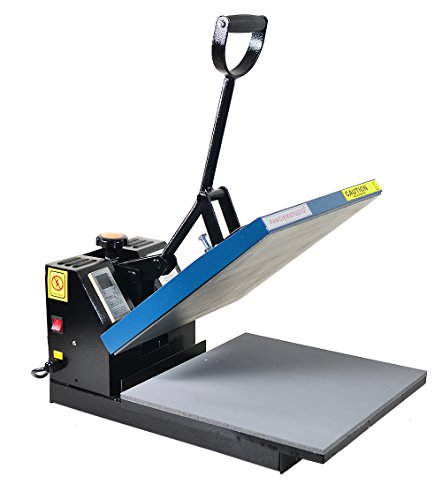
| Fancierstudio Digital Heat Press 15 x 15 Sublimation Rhinestone Heat | 15 x 15 in | 0-699 degrees F | Adjustable pressure, silicon-gel base board |
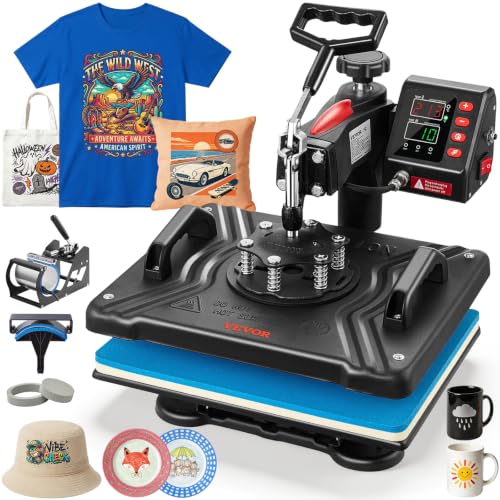
| VEVOR Heat Press Machine 12"x15" 5 in 1 360° Swing Away Shirt Press | 12 x 15 in | 0-450 degrees F | Pressure adjustment knob, 360° swing away |
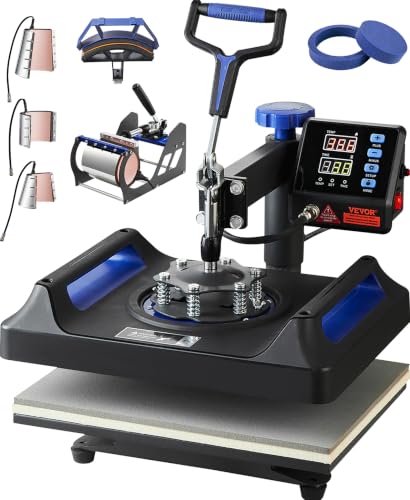
| VEVOR Heat Press Machine 12 x 15 Inch 8 in 1 Heat Press Sublimation Machine 360° Rotation Swing Away 8 in 1 Shirt Printing Machine Dual-Tube Heating for DIY T-Shirts Cap & Mugs Blue | 12 x 15 in | Not stated in the supplied listing information | Dual-tube heating, center-to-edge difference quoted at about 5 °C |
Disclosure: We earn a small commission from qualifying Amazon purchases at no extra cost to you.
As an Amazon Associate we earn from qualifying purchases. This page contains affiliate links, and we may receive a commission if you buy through them — at no extra cost to you.
As an Amazon Associate, we earn from qualifying purchases.
Last Updated: September 2026
Most heat press failures come down to three variables: temperature, time and pressure. If your HTV peels off in the wash, your shirt has a shiny scorched rectangle, or one corner of the design lifts while the other sticks perfectly, one of those three is wrong — and the fix is almost always diagnostic, not a new machine. Work through the checks below in order before you spend money.
The Problem: Why Transfers Fail
A heat press is a simple machine doing a fussy job. It has to hold a set surface temperature across the whole platen, hold it for a set number of seconds, and squeeze the transfer against the garment hard enough — and evenly enough — for the adhesive to melt into the fibers.
When one of those three drifts, you get a signature symptom:
- HTV not sticking or peeling after washing — usually not enough heat, not enough dwell time, or not enough pressure.
- Scorch marks, shine, or a yellowed rectangle — too much heat for the fabric, too long a dwell, or direct platen contact with no cover sheet.
- Press box marks on fabric — the impression left by the platen edge, made worse by too much pressure and a thin or compressed lower pad.
- One side sticks, one side doesn't — uneven pressure, an uneven lower pad, or genuine edge-to-center temperature variation across the platen.
Step-by-Step Solution
- Verify the actual platen temperature, not the display. A digital controller shows a setpoint. It does not prove the surface reached it. Check the reading with an infrared thermometer at the center and at each corner before you blame your vinyl.
- Preheat the garment for a few seconds. This drives out moisture and flattens seams and wrinkles. Damp cotton steals heat from the transfer and is a very common cause of weak adhesion.
- Set time from the vinyl manufacturer's sheet, not habit. Every HTV brand publishes its own temperature, dwell and peel instructions. Follow that sheet for the specific film you bought.
- Re-check pressure after every thickness change. Moving from a single-layer tee to a hoodie changes the gap. If your press has a pressure adjustment knob, reset it whenever the substrate thickness changes.
- Always use a cover sheet or Teflon sheet. It is the cheapest insurance against scorch and shine there is, and it keeps melted adhesive off the upper platen.
- Use a pressing pillow for seams, zippers and collars. A pillow raises the print area above the obstruction so pressure lands on the design instead of bridging over a seam.
- Test on a scrap of the same fabric. Polyester, poly-cotton blends and cotton all tolerate different temperatures. Sacrifice one scrap rather than one customer's shirt.
Fixing Scorch Marks Specifically
Scorch is a heat-and-time problem. Drop the temperature to the lowest value the vinyl sheet allows, shorten the dwell, and interpose a cover sheet. If your press is only running hot at the center, a two-layer teardown of the pressure setting will not help — that is a heat distribution issue, addressed below.
Fixing Uneven Pressure and Box Marks
Box marks are usually excess pressure plus a tired lower pad. Back the pressure off to the lightest setting that still gives full adhesion, and press the garment inside-out for a light second pass to relax the impression. If one corner is consistently weaker, the lower pad is likely compressed unevenly or the upper platen is not seating flat.
Fancierstudio Digital Heat Press 15 x 15 Sublimation Rhinestone Heat T-Shirt Machine15x15 B/BLK — Best for large front prints that need room around the design
The listing describes a 15-by-15-inch press with electronic time and heat control, a temperature range of 0-699 degrees F and a time range of 0-999 s. That platen size matters for one specific failure mode: if your design is close to the edge of a smaller platen, you get inconsistent edge pressure. More platen than design gives you margin.
The listing also states the pressure is adjustable, that there is a silicon-gel base board, and that Teflon coating has been added to the heat platen. Adjustable pressure is the single feature that lets you fix box marks without abandoning adhesion.
One inference worth stating plainly: a published ceiling of 699 degrees F is far above anything HTV or sublimation calls for, so treat the top of that range as headroom you will never use rather than a capability. The listing rates it at 110 volts and 1800 watts; that is the appliance rating only, and it does not tell you what your circuit can safely carry — check that with an electrician, not a product page.
Suits: crafters pressing large chest or back designs who want physical margin around the transfer. Limitation to weigh: the supplied listing information does not state a platen flatness tolerance or a temperature-uniformity figure, so you cannot judge edge-to-center consistency from the specs alone.
VEVOR Heat Press Machine 12"x15" 5 in 1 360° Swing Away Shirt Press Machine — Best for crafters fighting curled vinyl edges and mixed substrates
VEVOR's listing calls out a 0-450 degree F temperature range and a 0-999s timer with dual LCD display, plus a pressure adjustment knob described as letting you find the precise amount for the transfer. That pairing — a readable timer and a real pressure knob — is exactly the control set you need to run the diagnostic steps above.
The 360 degrees rotation swing away is pitched as protecting you from the high temperature upper platen and stopping transfer vinyl from curling up at the edges. If lifted corners are your recurring complaint, that is the relevant claim to weigh.
The listing also states over-heat protection and a built-in circuit breaker, a silicon-gel pad rated to withstand 250 degrees Fahrenheit without distorting, and a Teflon coated platen with a loud beep at the end of the cycle. Note the scope: that 250 degrees Fahrenheit figure applies to the pad, not the press ceiling.
Suits: makers who also press hats, mugs and plates — the listing includes a 6"x 3" hat/cap press, an 11 oz mug press and 5" and 6" plate presses. Limitation to weigh: the 12x15 inch platen is described by the seller as a money saver compared with the larger size, which is a smaller working area than a 15 x 15 platen.
VEVOR Heat Press Machine 12 x 15 Inch 8 in 1 Heat Press Sublimation Machine 360° Rotation Swing Away — Best for uneven-heat complaints, based on the center-to-edge figure stated in its own listing
The listing for the VEVOR Heat Press Machine 12 x 15 Inch 8 in 1 Heat Press Sublimation Machine 360° Rotation Swing Away (ASIN B099NCM9NC) addresses the uneven-transfer problem with a number. VEVOR states it uses dual-tube heating rather than single tube, and that the temperature difference is only about 5 °C between the center and the edge, versus more than 10 °C for what it calls the old-fashioned heating tube.
Treat that as a manufacturer claim rather than independent verification — but it is the specific spec to look for if half your design keeps under-adhering. The listing also describes the swing-away arm as applying pressure directly and evenly on the platen.
The listing bullets for the VEVOR Heat Press Machine 12 x 15 Inch 8 in 1 Heat Press Sublimation Machine 360° Rotation Swing Away 8 in 1 Shirt Printing Machine Dual-Tube Heating for DIY T-Shirts Cap & Mugs Blue (ASIN B099NCM9NC) describe a precise digital controller embedded with dual-screen displays, with (+/-) used to switch between ℃ and °F. That listing also states a 12"x 15" (29 x 38 cm) Teflon-coated heat platen for this model.
Suits: anyone whose main symptom is inconsistent adhesion across the design rather than overall failure. Limitation to weigh: the supplied listing information does not state a maximum temperature or timer range for this model, so confirm those with VEVOR before buying for a specific sublimation workflow.
Tips for Best Results
- Log your settings. Fabric, film, temperature, seconds, pressure setting. A notebook beats memory.
- Verify with an IR thermometer periodically, not just once.
- Replace a compressed lower pad. It is a consumable, and it is the quiet cause of half of all uneven-pressure complaints.
- Peel at the temperature the film specifies — hot, warm or cold peel are not interchangeable.
- Prewash-free garments can carry sizing chemicals that interfere with adhesion. Test one.
Common Mistakes to Avoid
- Cranking pressure to fix an adhesion problem that is really a temperature problem. You get box marks and still get peeling.
- Trusting the display over an actual surface reading.
- Leaving a press unattended because it has a timer. A timer is a cycle control, not a safety supervisor. General consumer product safety guidance is published by the CPSC.
- Reusing settings across vinyl brands.
- Pressing over a zipper or seam without a pillow.
How We Research
This site does not run a lab. For this page, published manufacturer and retailer specifications were read closely from the Amazon Creators API verified product records and the product listing feature bullets for each ASIN, all retrieved on 2026-09-09, and the specs were compared against the mechanics of the failure modes above. Where a listing does not publish a figure — platen flatness, uniformity tolerance, warranty length — that is noted as unstated rather than guessed. Consumer-safety context is drawn from public government resources.
Final Verdict
If you are troubleshooting rather than shopping, fix the process first: IR-check the platen, preheat the garment, follow the vinyl maker's sheet, and back the pressure off before you add more. That solves most cases without a purchase.
If the machine really is the bottleneck, my opinionated read of these three records: the VEVOR Heat Press Machine 12 x 15 Inch 8 in 1 Heat Press Sublimation Machine 360° Rotation Swing Away is the pick when your symptom is edge-versus-center inconsistency, because its own listing states a center-to-edge temperature difference of about 5 °C (Check Price on Amazon). If you press oversized front and back designs and want physical margin around the transfer, the 15 x 15 inch platen on the Fancierstudio Digital Heat Press 15 x 15 is the relevant spec (Check Price on Amazon). And if you need one machine for shirts plus hats, mugs and plates with an explicit pressure adjustment knob and a 0-450 degree F range, the VEVOR Heat Press Machine 12"x15" 5 in 1 covers that ground (Check Price on Amazon).
Check current price on Amazon for each before deciding.
Related Resources
- Choosing your first craft cutting machine
- HTV vs sublimation: which fits your projects
- Heat press pressing pillows and cover sheets explained
- CPSC consumer product safety
- USA.gov consumer protection
Sources and Methodology
Nothing on this page was pressed, timed, weighed or handled — this website does no physical or laboratory testing, and says so on every page. What sits behind these recommendations is a close reading of the Amazon Creators API verified product records and the product listing feature bullets for ASINs B0043H9FMU, B08W2NY9G8 and B099NCM9NC, all retrieved 2026-09-09, with each published figure kept in the scope its manufacturer stated it in. For heat presses specifically, that kind of spec reading tells you reliably which machine gives you adjustable pressure, a usable timer, a platen big enough for your design, and a published uniformity claim to hold the seller to — but it cannot tell you how a given unit will behave on your bench, which is why the troubleshooting steps above come first.